The web is changing. Good food is not.
Every time the web has reinvented itself, food content has reinvented itself along with it: from hand-built blogs, to YouTube channels and Pinterest boards, to fifteen-second vertical video. It's reinventing itself again as you read this. But the thing underneath it, a person cooking a real meal for people they care about, hasn't changed at all.
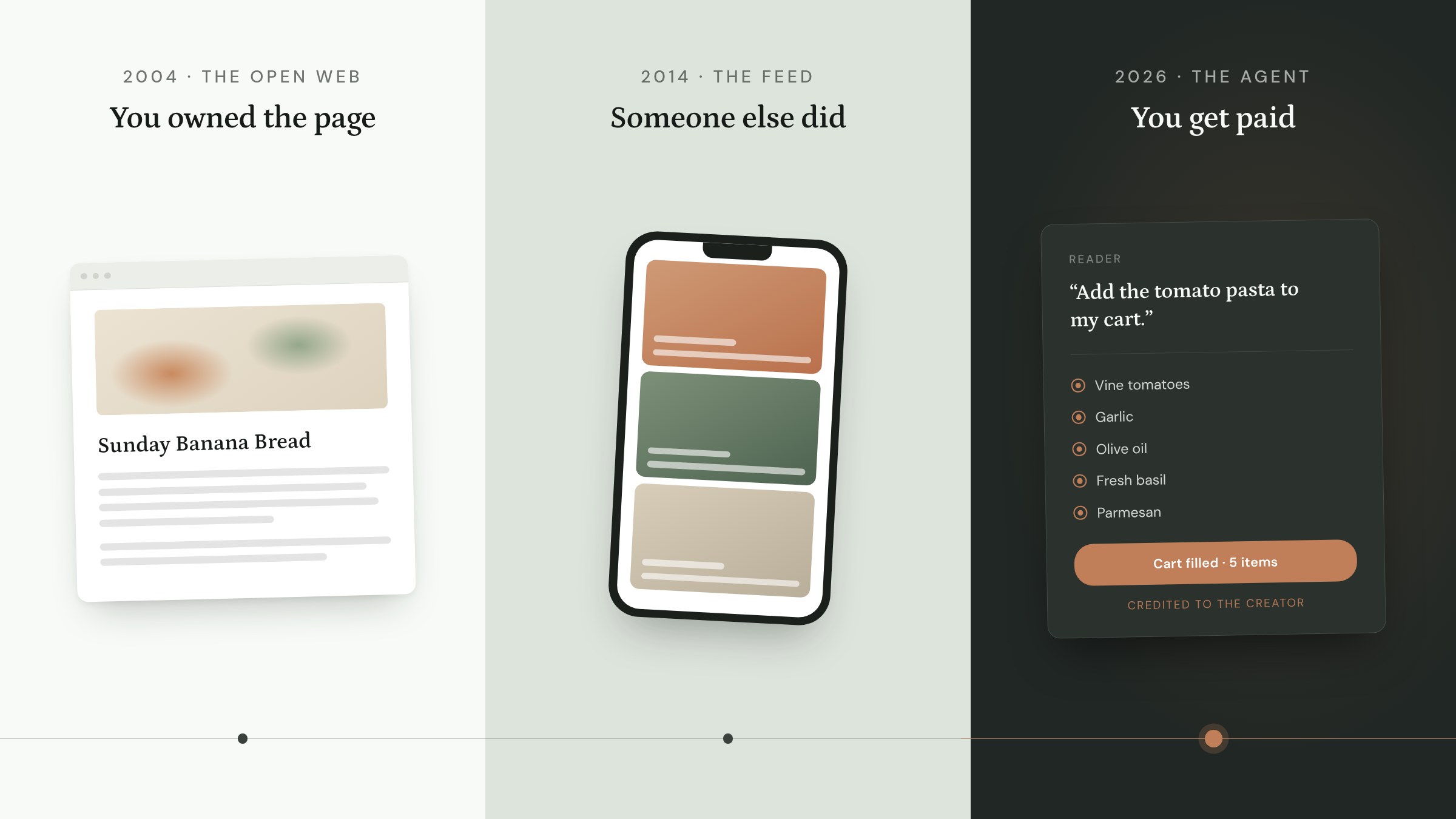
Food content is a useful lens on the web precisely because it has lived through every era of it. The story of the web is usually told in three chapters: Web 1.0, when people published pages and readers found them; Web 2.0, when platforms aggregated everyone into feeds; and whatever this new AI-shaped chapter turns out to be called. Food content has a chapter in each. This post walks through all three, with data, and ends with what the next era looks like for the people who make it.
Web 1.0: the open-web era
Food content's first internet home was the open web. Personal sites, forums, early recipe archives, and then, once WordPress and Blogger made publishing more accessible, the food blog. For the first time, a home cook in a small kitchen could reach the same audience as a magazine test kitchen. And many did.
This was the Web 1.0 spirit even where the tools were newer: you published pages on a domain you owned, and readers came to you. The formula that emerged was powerful:
- Search was the front door. People typed "banana bread recipe" into Google, and Google sent them to independent sites. Rank well for a handful of recipes and you had a durable, compounding audience.
- Display ads paid the bills. Ad networks turned pageviews into income. More traffic meant more revenue, so the incentive was simple: publish more, rank higher, keep readers on the page longer.
- The personal voice was the moat. What separated a beloved site from a recipe database was the person behind it: the family history behind a dish, the failed test batches, the photos of a real kitchen.
It worked. Food creators built genuine media businesses on this model, with teams, cookbooks, and millions of monthly readers. An entire ecosystem grew around them: recipe card plugins, food photography courses, ad networks built specifically for food publishers.
But the model had a flaw baked in: the economics rewarded *pageviews*, not *cooking*. That flaw shaped everything that came next.
Web 2.0: the platform era
Web 2.0's promise was participation: everyone a publisher, no domain required. In practice it meant consolidation. The audience moved into a handful of feeds, and food content followed it there: recipe videos on YouTube, food photography on Pinterest and Instagram, and eventually the fifteen-second recipe on TikTok.
Ask a new food creator in 2023 where they're building, and almost none of them will say "a website." They'll say TikTok or Instagram, and the audience data explains why. Roughly 72% of Gen Z say they use TikTok for meal inspiration, and for younger audiences "searching for something to eat" now means swiping through a feed, not typing into Google. If you make food content, the platforms are where the people are, so the platforms are where creators go first.
And to be clear: it works as a *discovery* engine. Food is perfect algorithm fodder: visual, shareable, satisfying in fifteen seconds. Careers get launched from a single viral reel.
But the platform era ran on a bargain that has gotten steadily worse. You bring the content, the platform brings the audience, and the platform keeps the relationship:
- You don't own the reach. Instagram now shows a typical post to only about 5–8% of your own followers, and organic reach dropped another 12% from 2024 to 2025. The audience you spent years building is behind a dial someone else controls.
- The money is thin and concentrated. Median creator earnings *fell* from $3,500 to $3,000 a year, while the top 10% of creators now take 62% of ad payments (up from 53% in 2023). The creator economy is a $250B+ market where more than half of creators earn under $15,000 a year.
- A platform change can erase you overnight. Every algorithm update, policy shift, or ban scare is an existential event for a business built entirely inside someone else's app.
Which is why the standard advice has always been: use the platforms for discovery, then bring people back to a website you own. Except right now, the owned side is getting hit even harder.
The transition underway: AI broke search
For twenty years, the open-web side of food content had one reliable front door: Google. That door is closing, and its closing marks the end of the second era as clearly as the rise of the feed marked the end of the first:
- Most searches no longer produce a click at all. Roughly 60% of Google searches now end without a click to any website; by some measures it's nearly 69%, and 77% on mobile.
- AI Overviews answer the question on the results page. They now appear on nearly half of all Google queries, and when one is present, the click-through rate for the top-ranking page drops by roughly 58–61%.
- Food content is among the hardest hit. Food & Drink was one of the fastest-growing categories for AI Overviews in 2025, and informational niches like recipes have seen traffic drops of 40–70% because the AI's summary is "good enough." Premium publishers overall saw Google referral traffic fall 10% year over year, and non-news sites, the bucket food sites fall into, fell 14%.
Meanwhile, the pages themselves collapsed under their own business model. Because display ads pay per impression, the recipe migrated to the bottom of a long scroll, below a life story, three ad units, and a video player that follows you down the page. "Jump to recipe" became a punchline. None of that happened because creators got greedy; it happened because impressions were the only reliable way to get paid, and the business model beat the reader's actual goal: *get cooking.*
So here is where the platform era leaves food content: the feeds where creators build first don't pay and can't be owned, the website that can be owned is losing its traffic to AI answers, and the underlying work, your recipes, has already been extracted to train the very systems answering in your place. The value flowed out; nothing flowed back.
What's dying is a business model, and one that was already failing the people it served. Food content itself has never had more of an audience.
The third era: from pageviews to real meals
Every era of the web gets defined by its unit of value. Web 1.0 measured pageviews. Web 2.0 measured engagement. The era now taking shape is agentic: software that doesn't just show you information but acts on it. For food content, that changes the question entirely. Not "how do I get more pageviews?" but "how do I turn a viewer into a real person cooking my recipe, and get paid fairly when it happens?"
That's the question we're building toward at Peristyle. A few things we believe will define the third era:
1. The owned website wins again
The long-term winner of all this disruption is the thing Web 1.0 got right: the owned website.
Walk through the alternatives. Platform reach is rented from an algorithm that shows your work to a sliver of your own followers. AI answers are intermediated: someone else's interface, someone else's rules. The website is the one surface where you own everything: the design, the reader relationship, the data, the monetization, the domain that compounds authority year after year. Both previous eras ended the same way: the platforms churned, and the people who kept building on their own land kept the equity.
And the food site's bad reputation has nothing to do with websites as a medium. It was never the website that failed; it was the Web 1.0 *architecture*, twenty years old and buried under plugin stacks, page builders, and ad-network templates that made every food site slow, cluttered, and interchangeable. Readers didn't leave websites for feeds because feeds were beautiful; they left because the sites weren't.
That constraint is gone. A modern food site built with Peristyle can be genuinely more beautiful than any feed: editorial typography, art-directed photography, pages that load instantly and put the recipe where it belongs. In a world where every AI can generate infinite mediocre content, a beautiful site is the visual proof of craft, the same signal a beautiful cookbook sends on a shelf full of pamphlets. The creators who treat their website as their flagship instead of their archive are the ones this next decade favors. The foundations of this we’re possible before but they could not be executed to the same level of quality as now.
2. AI traffic becomes a revenue stream, not a leak
Today, when an AI assistant reads your recipe, you get nothing. In the third era, that traffic pays. The infrastructure now exists for AI agents to pay creators per request: a machine-readable storefront for your content where you set a price per request, per day, or per month, while human readers are given more of an opportunity to have an amazing user experience.
Instead of AI silently extracting your work, it becomes a paying customer, and you get control of, and credit for, what you created. And the same AI systems draining clicks reward the creators they can cite: sites referenced in AI Overviews see about 35% more organic clicks than uncited competitors.
3. The recipe becomes actionable
The biggest friction in food content has never been finding a recipe. It's everything after: translating it into a shopping list, matching it against your pantry, and actually getting the ingredients. That friction is why so many saved videos and bookmarked recipes never get cooked. The first two eras could only ever hand a reader information; what they did with it was their problem.
An agentic web closes that gap. When a reader asks their assistant to shop a dish, each ingredient can be matched to a real product at their actual store, the cart filled, and, critically, the sale credited to the creator. The recipe stops being a page you read and becomes a meal that arrives at your door, with the person who developed it earning from the transaction.
This is a fundamentally better monetization event than an ad impression. An impression means someone scrolled past your work. A filled grocery cart means someone is *cooking your food tonight.*
4. Structure and accessibility stop being optional
For AI to recommend your recipes, credit you, and shop them, it has to understand them. That means structured recipe data, Schema.org markup, real alt text, and voice-readable steps stop being SEO nice-to-haves and become the core product. The sites that win the third era will be built for search engines, AI engines, and screen readers with equal seriousness, not with a stack of plugins, but by default.
5. The feed and the website stop competing
Social isn't going anywhere; it's the best top-of-funnel food content has ever had. What changes is what it feeds into. Instead of a reel pointing to an ad-choked page (or to nothing at all), it points to a site that can turn the moment of inspiration into action: see a video of a recipe you love and instantly get those ingredients filled into a grocery cart from your local grocery store. The 72% of Gen Z finding meals on TikTok aren't a threat to the owned food site; they're its future readers, if the destination is worth arriving at.
6. The reader experience gets its dignity back
When your income no longer depends on trapping readers on the page, you can give them what they came for: calm typography, the recipe where they expect it, step timers that keep running while they cook, a clean, ad-free printout with just the ingredients, steps, and times. Ads can still exist, on your terms and at a density you choose, because they're one revenue stream among several instead of the only one.
Everything readers have complained about for a decade gets fixed not by charity, but by better economics. There are also numerous ways that a user will stay on a page with aligned incentives, the biggest being when a person is actually cooking and using the instructions to cook the meal.
7. The personal voice matters more than ever
If an AI can generate a plausible recipe for anything, what's scarce? Trust. A recipe that's been tested in a real kitchen, by a real person, with a track record: that's what readers will seek out and what AI systems will need to cite and credit. The moat of the first era turns out to be the moat of the third. The creators who built audiences on honesty and craft are holding the most valuable asset of the next era.
What hasn't changed
It's worth ending where we started. Through three eras of the web, from blogs to Pinterest to Instagram to TikTok and now AI, the underlying human act is identical: someone wants to put good food on the table, and someone else knows how to help them do it.
The first era connected those two people through search results and paid the creator in ad impressions. The second era connected them through feeds that don't pay, and it's ending with searches that no longer send a click. The third era connects them more directly than either, recipe to cart and kitchen to kitchen, and pays the creator for the thing that actually matters: a meal that got made.
And the center of that third era is the same place it was in 2004: a website with your name on it. Just, this time, one worthy of the work: beautiful enough to be the destination, structured enough to be the source, and owned enough that no algorithm can take it away.
The web is changing. Good food is not. The creators who thrive next will be the ones whose tools were built for both.
---
*Peristyle builds websites and products for food creators, ready for the next era of the internet. If you're a food creator thinking about what comes next, take a look at becoming a founding partner or try the Peristyle Grocery Cart on your own recipes.*
Sources
- Semrush: AI Overviews Study – AI Overview prevalence and category growth, including Food & Drink
- Ahrefs: AI Overviews Reduce Clicks by 58% – CTR impact when an AI Overview is present
- Search Engine Land: AI Overviews hurt click-through rates – Seer Interactive CTR data (1.76% → 0.61%)
- SparkToro: Less than one third of Google searches still send a click – zero-click search share
- Search Engine Journal: AI Overviews' impact on publishers – Digital Content Next referral-traffic declines
- Morning Consult: How social media factors into Gen Z's recipe discovery – Gen Z food discovery on TikTok/Instagram
- Influencer Marketing Hub: Creator Earnings Report 2025 – median creator earnings and income concentration
- Neal Schaffer: Creator economy statistics – market size and income distribution
- Stack Influence: 2025 social media algorithm changes – Instagram organic reach decline